
Showing posts with label share crop. Show all posts
Showing posts with label share crop. Show all posts
Friday, October 10, 2014
Farmland on Hulu
I'm sure by now you've heard of the documentary "Farmland" directed by Academy Award winning director James Moll. Well, in case you missed it in the theater's, you can now watch it on Hulu. Just click here to watch it. I thought it was a very educational documentary for folks who know very little about modern day agriculture. Enjoy.

Friday, May 16, 2014
How Does Farmers National Manage My Farm?

For more information on FNC's farm management division go to Farmers National's website. Looking to buy land? Go to Farmers National KC, email at info@farmersnationalkc.com Or call 913-837-4665.
Monday, December 23, 2013
Crop Inputs
Changes For 2013

There were some changes to the amount farmers and farm owners had to put into their farms. Crop production was up 1 to 4%. Seeds were up 5 to 10%. Machinery went up 1 to 6%. Fertilizer, interest and fuel all remained the same.
These are trends to keep an eye on as we move into 2014. It can help you make an informed decision on what kind of farm operation you want to run.
Have a Merry Christmas folks!
Friday, December 20, 2013
Analyzing Operating Alternatives
With all the information I've given you on the different ways to run your farm, the next question you should be asking yourself is what's the best way for me? How should I run my farm operation? You should use the market indicators to help you make an informed decision.


Actual Negotiated Cash Rent
You need to find out what land is going for in your farms area for cash rent. If it's high maybe that's the way you want to go. If it's low you may take an alternative such as share crop or custom farming. You have to know what you're comfort level is. That's the best way to get started.
Actual Production History
This is a valuable tool. This will tell you what the land has produced in the last handful of years. You will know if it's good producing land or bad producing land. This is an excellent tool when deciding what farmland to buy. I highly suggest getting this before making a purchase or decision on how to run your land. I would also suggest having a farm manager look over this for you. Sometimes it's like reading a different language.
Guaranteed Revenue Protection
What kind of crop insurance do you have? What's the protection you have against a bad crop year? This will help you know if you can take a bigger risk in doing custom farming or if you need to play it safer and do cash rent.
Projections of Future Pricing
For this I would hire a farm manager or consult with a farm management company for. They have employees that all they do is look at farm futures. They are a good tool and can help you make better decisions on how you want to handle your farm going forward.
Friday, November 22, 2013
Risk vs. Reward
Most farms in most communities have several operating alternatives. The fall along the line of the old risk vs. rewards slide. You have cash rent, bushel leases, net share leases, crop share, blended custom, custom farming and direct operations.


Cash Rent
There is typically no risk in production or price when it comes to cash rent. There is usually an agreed on fixed amount based on a few things. Your farm production potential, the price outlook for commodities, government payments, competition for land in your area and any improvements needed. An example of improvements would be houses, buildings, grain storage, irrigation equipment or tiling. Some people do half payment at the beginning of the year and then the rest at the end of the harvest. I highly suggest you receive payments in advance for the full amount.
Bushel Leases
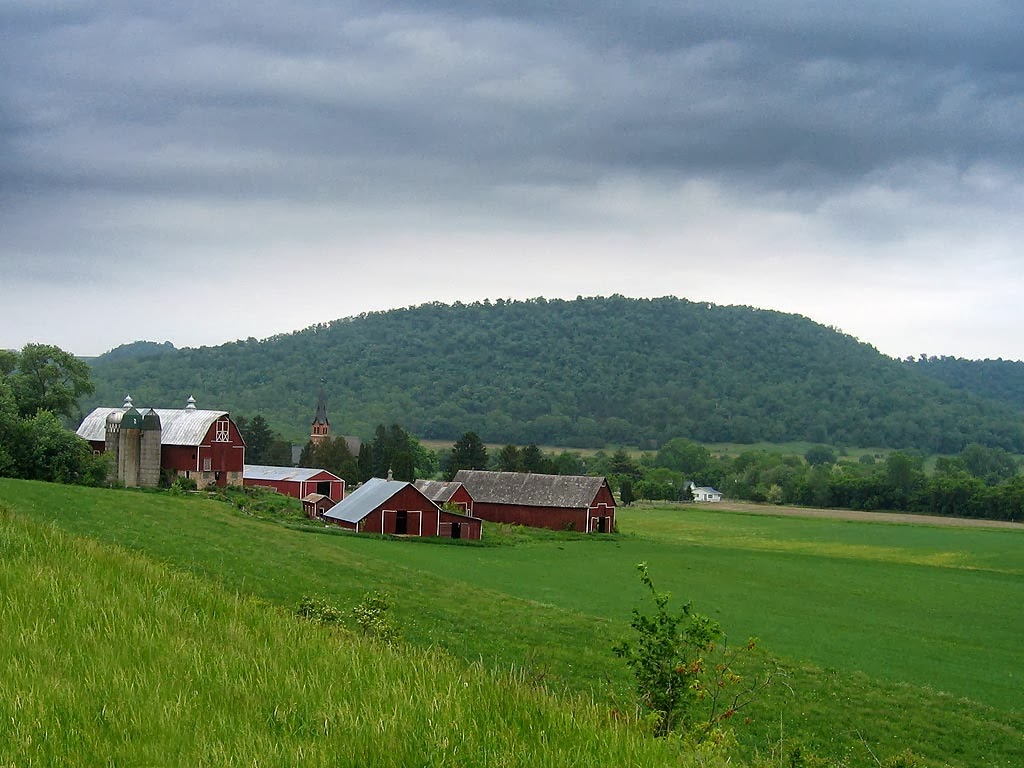
In this case you would share the risk and reward of the price. It would entail a fixed number of bushels of a crop delivered to a specified location by a certain date. This kind of deal is gaining popularity due to higher commodity prices. It's very attractive to some large operators.
Net Share Leases
Here you would share partial risk and reward of production and price. This is very popular with large farm operators. The reason is that there is no inputs to keep track of and divide. Many landowners like this as well. They have no inputs to pay at all.
Crop Share

In this you would share both the risk and reward of production and price. There are some common modifications to this. It can reduce input expenses of the landowner. Inputs would be seed, chemicals, harvest and trucking and irrigation and fuel. You can adjust percent of crop to the owner. For example, you can change a 1/3 share to a 2/5 share or a 2/5 share to a 1/2 share. You could also add supplemental cash rent which would often be due in the fall.
Blended Custom

This is an enhanced sharing of production and price risk. Landowner pays all crop input costs and receives 80% to 90% of the crop. Operator provides the labor, machinery and fuel. The operator receives 10% to 20% of crop and government payments. The operator is motivated to produce well. Owner is rewarded for additional investment in crop inputs.
Custom Farming

Here the owner would assume all risk of both production and price. Landowner pays all input costs. Landowner hires all operations completed. Landowner receives all crop revenue and government payments.
Direct Operations

In this one owner assumes all risk of both production and prices. The owner would pay all input costs, employs labor and owns equipment and may own livestock. The owner would receive all crop and livestock revenue and government payments. The owner may also do recreational leasing. Remember, profits would vary by operation.
Tuesday, November 19, 2013
Your Personal Goals
How to operate and own a farm may not be the same from one owner to the next. You may have different ideas of what you want you farm to look like, produce or you may have long term goals. Here are some of the different ways a farm can be operated and managed.


Generate Income
There are many different ways to do this. You could farm it yourself. Under this you would be the operator, assume all the risks but reap all the rewards. You could custom farm it. Here you pay someone a fee to farm it but you take in all the rewards but assume all the risk. You could share crop it. Usually this is a 1/3 to 2/3 split. Meaning you would put in 1/3 of the cost of fertilizer and other cost and you would reap 1/3 of the profits. The farmer would get the rest. Finally you could cash rent it. This the safest way to do it. You rent the land out to a farmer who pays you an agreed upon amount. He then takes all the risks and rewards.
Maintain Family Legacy

Perhaps you're thinking the long game here. Maybe you want something to pass down to your children or grandchildren to help secure their financial future. There are ways to do this. Often times it's done through a will. I will go into this in much more detail in later posts. But this is something many people do and are interested in.
Make Improvements

Are you willing to put in the money to make your farm more profitable? What are the improvements I'm talking about? Things like terracing, removing timber, shrubs or leaves and adding irrigation are just some ideas. This would be something you should consult with your farmer on. He'll know whether or not it's worth doing or not.
Manage Income
How hands on do you want to be? Some people are just fine with handle all the farm finances. Others just want to get there check and call it good. Folks who like to do that should consider hiring a farm manager. They'll keep an eye on your farm and your income. This way you don't have to worry whether or not your being cheated.
Maximize Income
If you're an astute farmland owner you probably already have a grasp on this. Two things can really help you maximize your farm. First, and most importantly, find a trust worthy farmer. This is so important. If you have a farmer that's treating you fair and has a good track record of such, take care of him. Your farmer is your gateway to success. Another idea is to hire a farm manager. They make sure the farmer is putting in fertilizer when needed, planting when needed, harvesting when needed and many other things. If you are uncomfortable with your situation, this is the best way to ease your mind.
How Do I Feel About Risk?
Some people love to gamble. Others like to play it close to the vest. Run your farm how you feel comfortable. Remember, it's your farm. So run it how you see fit. If you like the idea of the gamble and putting some skin in the game, go ahead and custom farm it. If you like getting a check on the first of the year and being done with it, then cash rent it. Let the farm match your personality and you'll be a whole lot happier with it.
Do I Want To Add To My Farm?
This is where you decide if you want to just own one farm or do you want to expand your business. Here you're doing good. You understand the industry and you feel comfortable with your farmer. Why not expand your farming business. You could just buy more land out right. Or you could flip the land you currently have to buy a much larger tract. There's no reason you should stop at one farm once you are comfortable financially and personally with the farming business.
Tuesday, October 15, 2013
Farm Management. Is It Right For You?

What are some possible expenses to think about when coming up with a management plan? Think about the size of the field. The reason is obvious once you give it a second. The larger the field the larger the equipment would have to be and may be used by more than one operator at a time. Also, think about what you want your return on investment to be. To possibly boost that up a bit you have to think about putting back into the land as much as you take out. If you continue to work your farm to death eventually you'll kill the soils and you won't be able to produce on it anymore. A good farmer or a good farm management company can do that for you.

A Cash Rent Lease is Not a Management Plan!
A cash rent is simple. Farmer farms and you get your check. That's it. But how do you know you're getting the most out of your farm? What if you want to custom farm or do a share crop? This is what a farm management company can do for you. It can require routine soil tests and review them. Require actual yield results each year. They can do this through a insurance yield approach. They will meet the operators yearly. During those meetings the farmer and manager can create a plan for the farm including a fertilizer and herbicide plan. The management company can stipulate who maintains improvements on the farm. The best thing a farm management company can do for you is keep regular communication and general farm appearances. This is very important.
Friday, September 20, 2013
Unique Midwest Opportunity
A Unique Opportunity


Missouri has a culture of cash rent as compared to a share crop culture such as Kansas. Missouri also has a free capture on water for irrigation. That means any water on, borders or adjacent to the property can be use for irrigation. In Kansas you have to get permits to use water and usually you have a limit in the amount.
However, for the more seasoned and aggressive investor, Kansas may be the one for you. Share cropping is the norm in that side of the border. If you feel comfortable enough and willing to take the risks, Kansas provides that option to you.
The Efficiency of Farmland
Let's compare Iowa to Eastern Kansas and Western Missouri. In Iowa per acre you can get 280 bushels per acre with a rent of $450 per acre. That would make your return on investment 4.5% at a per acre cost of $10,000. Now let's compare that to Kansas/Missouri. You would get 170 bushels per acre with a rent of $110 to $350 per acre. That would bring in a return on investment of 4% to 5% at a per acre cost of $5,000 to $2,500. Based on comparative production of bushels, per acre cost in Eastern Kansas and Western Missouri would be $6,072.
Common Mistake
There are many things we hear over and over again in our industry from buyers. But by far this is the most common thing we hear. "I had a chance to buy that for $_____ back in _____ and didn't do it. I'm still kicking myself." Do yourself a favor, don't be that guy. We can help you avoid that. Call us at 913-837-4665 or email us at info@ruralkc.com.
Friday, September 13, 2013
Managing Risk On The Farm

Consider A Farm Manager

For a fee, typically 8% to 10%, a farm manager can make sure your farm is operating at an optimum level. They can determine the best lease arrangement for you. They can negotiate the farm lease for you. A farm manager can oversee your tenant farmers usage of your land. They can put together a projected investment analysis. They can assist in tax strategies. A farm manager can determine value of government farm programs. They can assist you in a succession plan. They can collect the rental payments. A farm manager can pay farm related bills. They will also work in different lease options such as cash rent, share crop or custom farm leases.
Crop Insurance

How does crop insurance work? It'll insure a fixed volume of grain or revenue for your farm. It starts with a historical farm yield record. Typically over ten years. The insurance will be a percentage of that historical yield.
Let's do an example. Let's say 100 bushels is the 10 year average of the farm. You choose an 85% coverage. You can choose anywhere from 55% to 85% coverage. Thus 85 bushels is guaranteed. Now, let's say 2012 you got a 50 bushel yields. 2012 was the worst drought we've had in the Midwest in fifty years. Your insurance will pay for 35 bushels. 85 was guaranteed when 50 were harvested. So you take 85 minus 50 to come up with the 35 bushels. You would get payed $280 per acre assuming an $8 market price times 35. Then you would add the 50 bushels at $8 is $400 per acre. The total revenue would be $680 per acre. Basically it's the market plus the insurance.
Is it more complicated than that? Sure. But I didn't want to hurt your head too much and my capacity for math only extends so far. As a matter of fact, I try to stick to doing math monkeys can do.
Crop Insurance Is A Landlords Tool
This will help you keep track of how your farm is doing. It will be a third party hard copy record of the farms production history by year, crop, acreage and yield. It's a useful tool for income projections and land values. It can be a measurement of the tenant's performance. It's added security, tenant oversight and surveillance. Remember, insurance fraud is a crime so it'll help you from being taken advantage of. It backstops grain marketing. Finally, it's an added loan security and guarantees cash flow.
Tuesday, September 10, 2013
What's In A Farm Lease?
What Does A Farm Lease Look Like?

With all that info about different kinds of farm leases I realized I never talked about what is in an actual farm lease. A farm lease tends to be in multiple years. Three years typically. The reason for a multiple year lease is there is no time wasted in year to year negotiations. And a farmer is more willing to improve the ground if he knows he has the land over the next couple of years. If you do a year to year lease you run the risk of a farmer abusing the land to get as much out of it that year alone and not worrying about the next year.
The lease tends to have two different forms of payment plans. It'll have it all upfront at the beginning of the year or it will have half before planting and the other half after harvest. Most investors like the all upfront for obvious reasons, but if you trust your farmer you may want to give him a break and do half before planting and the other half after harvest.
We highly recommend a written lease. That way no one can suddenly come down with a case of amnesia and say they didn't agree to something. It keeps everyone straight. However, verbal agreements are common in the farming industry and are legally binding.
Check out the sample below of what is a typical written cropland cash lease.


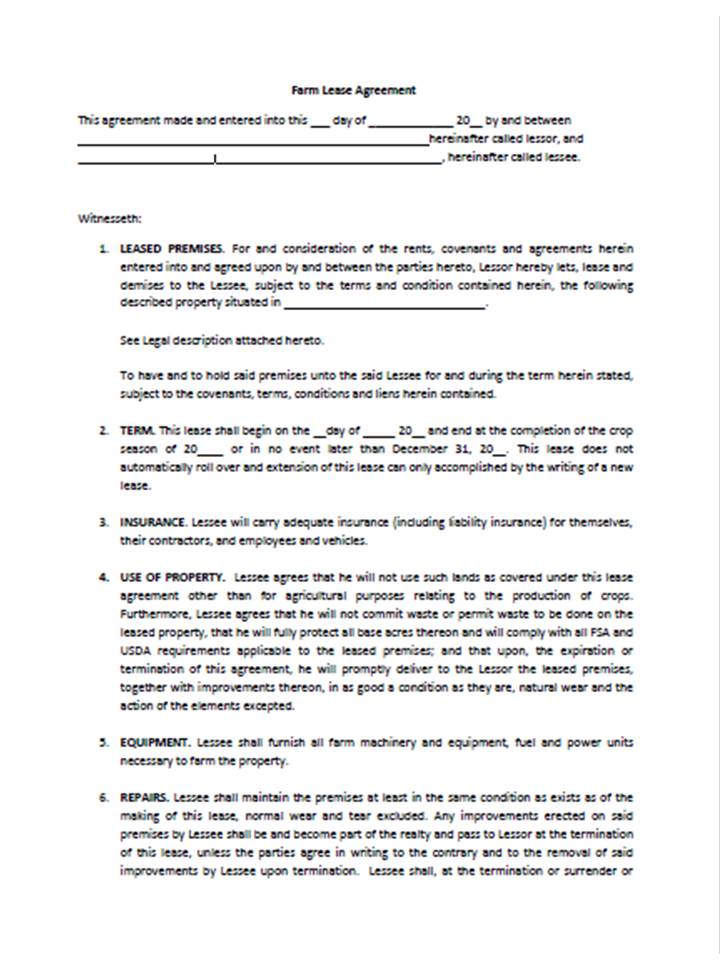


If you would like more examples of share crop, cash rent plus leases one or wish to talk to us about any cropland issues don't hesitate to email us at info@ruralkc.com or call us at 913-837-4665.
Friday, September 6, 2013
Different Ways To Lease Farmland
How Involved Do You Want To Be?

There are four ways you as an investor can be involved with the farmland operation. You can do direct farming which means you are the farmer and you handle everything involved. You can do custom farming which you don't farm but you take in all the profits. You can share crop which you share the profits with the farmer. Or you could just do traditional rent where you would just be a landlord.
What Is Custom Farming?

In custom farming you do everything but farm the land. You provide the land and management. You provide the inputs which includes seeds and chemicals. The farmer would provide the equipment and labor. You would pay the farmer a lump sum and optionally a percentage of the profits. You will get all the profits here. You get all the tax benefits of being a farm operator. You can take advantage of any government programs available. You don't have to worry about any expensive equipment cost. However, you do shoulder all the risk. For example, if the crop is bad you're the one who suffers. Remember, the farmer gets paid a lump sum.
What Is Share Cropping?
In share cropping you provide the land. You may pay part of the expenses. For example, we will assume you agreed to a 1/3 2/3 crop share. So you would pay 1/3 of the chemicals. You would then get 1/3 of the crop income.
The farmer would provide the equipment and the labor. He would pay 2/3 of the chemical costs. They would pay all the seed costs and all of the fuel costs. The farmer would end up getting 2/3 of the crop income.
What Is Cash Rent?
Here the farmer agrees to pay a specified rate per acre regardless of the crop yield. The advantage of a cash lease is it's predictable and easy to manage. The disadvantage is that when the prices are high you may be getting less than the value of the land warrants.
What About A Hybrid Cash Lease?
Here cash rent would be set at a base rate regardless of the crop yield. A bonus is paid to you if prices hit a certain agreed upon level. For example, base rent is $125 per acre but corn hit $7.50 at a given date an additional $25 per acre is due. Or you are given a base cash rent plus a share crop bonus if production is high. The advantage is it protects your investment if the prices go up. Disadvantage is it may discourage some farmers from competing for your land. It may also cause some farmers from paying a high base rent.
Tuesday, September 3, 2013
Farmer Is The Key To Sucess
The Renter

Your farmer will have the same interests you do. He wants you to find a good deal on land. The less you pay for the land the less you have to charge him rent. He has no interest in farming poor land. He has no interest in farming frequently flooded land. He only wants the best possible ground for you. How can he help us do this? He has local knowledge.
Local Knowledge

He'll know all about the ground. He may know of ground that is not on the market. He may know of additional renters. He can give us a look into the local market. He may know of hidden traps or issues. He knows of good land that is too isolated to farm. And, best of all, he may know the motivations of the seller.
What Motivates the Renter

Things that motivate a farmer is what his rental rates will be? Can the land be share cropped? Will he have to buy more equipment? How long will the lease be? Things to to think about when drawing up a lease would be can the land be improved and will that lease allow the farmer enough time to make the improvements?
What could need improving? I may not have been in production for awhile so the farmer may have to clean it up and til it. Are there fences to move? Will it need to be terraced to improve water flow? Is it a long distance from his operation? How much can the land be improved over time?
How To Use The Farmer In Negotiations

Now what if you put in an offer before you find a farmer? You can make an offer contingent upon you finding a farmer. This would motivate the seller and agent to help you find a good farmer. If you don't find a farmer then the sale is null and void. Let's say you find some farmers but all their rent bids are low. You can renegotiate the price based on this. Also, if you talk to farmers and they say the land is bad you can then cancel the sale and move on.
Friday, August 30, 2013
So Now You're Ready
So Now You're Ready to Look
How much land is available? Well, if you're related to a farmer or a friend of a farmer then a lot of land is available. I'm going to assume most of you aren't related or a friend of a farmer. So, what does that mean for you?
Only 1% of the total amount of cropland is sold each year. Most of that land never makes it to the market. Why? It's sold to family or friends of the farmer. People living in or associated with the community the farm is located tend to get first crack at it.
This puts non-local investors at a major disadvantage in acquiring the best farmland. Less than 1/2 of 1% of all US cropland is available for public purchase. Which should lead you to the next question. How do you sort this all out? How do you access the best farmland which usually never makes it to the public market?

There are three parties to the sale. There is the seller which can be a farmer, investor or estate. The investor which tends to be someone from out of town looking to expand their portfolio. And the renter who is also the farmer. The renter is what we need to help us out. The right renter will help you balance out all these issues.

What can that farmer do for you specifically? Look for that in my next post. :)
Friday, August 23, 2013
What Could Go Wrong?
So Now You're Ready to Buy
You have everything you need. The property you're looking at has good soils. You have obtained the production history and that comes back strong. The property is priced reasonably. You have all the information you need. What could possibly go wrong?

Not So Fast My Friend!
There still may be some hidden problems.
What Else Could Go Wrong?
You could get fooled by high rental rates. Previous farmers could have cherry picked the history and it may include share cropping. Not all the land may be included in the history. The recent rental may not be typical of what that land yields. You may be looking at numbers that only make the land look good during high commodity prices.
Other mistakes are some people don't shoot for the best farmland. They may only buy land that is marginal. The buyer may decide to be unrepresented forcing them to rely on the word of the seller's agent. You may be buying land that's seems too good to be true. Remember the old saying? If it's too good to be true it probably is. You could drive too hard a bargain with the farmer making it not worth the farmers time to really take care of the land. And a common mistake is not doing a written lease. Often farm deals are done verbally but that leaves the land owner vulnerable. Always, and I mean always, do a written lease.
Tuesday, August 20, 2013
The Steps to a Successful Cropland Purchase
Steps to Success
Now that I've shown you a little of what we do. The next step is how do we go about implementing it. Well, there are three steps to a successful cropland purchase. Identifying good land, look into crop insurance and find comparables.
The first step is identifying good land. The soil maps we talked about will do that for us. The maps will tell us soil ratings, soil types, prime farmland ratings, flood zones and much more.
The second step is looking into crop insurance.

Crop insurance can be a life saver. It can help you avoid major problems when the crop fails. It has been especially important in the last couple of years due to the drought which appears to be ending. What you will find getting crop insurance is that it records historical production trends for a series of years, it reports to the USDA and new buyers are eligible for crop protections.
The final step would be to find comparables to make sure you're getting a good deal. You can also look into state reports on recent sales. However, state reports and comparables suffer from not being timely.
One thing to keep in mind is land can vary greatly in the same area. Some land slopes a lot requiring terracing. Some land floods too frequently. Some land just has poor soils. Some land is just too remote. And what I mean by too remote is it may be too far from any farmer to not make it worth farming. You have to consider how much it money it takes for a farmer to move his or her equipment from property to property. That is something to consider.
Friday, August 9, 2013
How to Make Money Off Cropland
There are many ways people get revenue off of cropland. The most traditional way is through the annual income, such as cash rent or share crop, and land appreciation.
Annual income can come in various different ways. One way is cash rent. This is usually gain by receiving bids from farmers and they tend to be competitive. This is the way most first time investors go. It's the simplest way and has the least amount of risk to the investor. The second way is share crop. This tends to be done by more experienced investors. They are typically 1/3 2/3 shares. The positive is the investor usually makes more money this route. However, they are usually more involved in the day to day decision making and if the crop fails or comes in poorly they take a hit along with the farmer. And the final way to make income is through land appreciation. I've gone over this a lot but to summarize it, cropland averages a 6% increase in appreciation annually over the last 40 years. And we saw a massive jump in the last two years averaging 10% to 30%.
Now for the additional streams of revenue most people don't think of.

One additional source would be mineral rights. This pertains to everything below ground of the property. Things such as oil and gas leases and coal are the most common. Another one is hunting leases. The price of a hunting lease varies from property to property and how it's decided. For example, you can decide the lease per acre, per hunter or, if it's a wetland, it could be a wetland lease. Sub surface water rights is also another issue to think of. Not too big of a deal in wet areas but places like western Kansas it can be an issue. There are also government programs in place. There is the conservation preserve program or CRP. That is when the government pays the land owner a yearly amount to allow the land to grow naturally. The is wildlife habitat incentive programs or WHIP. It's similar to CRP but instead of just leaving it alone the government creates a habitat to promote wildlife growth. There is also wetland reserve program or WRP. Similar to CRP. Allows a wetland to remain untouched and promote wildlife growth. And finally there are wind leases.

Wind leases are becoming more and more common. The issue is you have to have your land adjacent to other turbines to tap into a wind lease. You have to think of it like an electric grid. And it's expensive to put in so they will only add on to wind farms and rarely put up new ones.
Subscribe to:
Posts (Atom)