Showing posts with label custom farming. Show all posts

Tuesday, August 5, 2014

Two New Varieties of Winter Wheat

Wheat growers in the Central US have learned about new Winter Wheat that will hit the market in 2015.

In a recent story by Agriculture.com, Syngenta announced the launch of SY Clearstone CL2 for Montana and Western North Dakota.  Also, Kansas State University's KanMark will be marketed to Kansas and the surrounding states.

"SY Clearstone CL2 is an ideal option for planting this fall because it excelled in a broad range of yield trials in this area and combines excellent yield potential with the agronomics growers have been looking for," said Corey Dathe, Northern Plains cereals key account lead, Syngenta.  "As certified seed, it provides growers with added assurance for consistent performance and high quality."

A hard red variety, it is a taller, semi dwarf variety with good test weight and can stand up to harsh winters.  It has high protein content with a two-gene herbicide tolerance.  It gives growers better weed management options while still offering a high yield.

KanMark is more suited for the central Plains.

It is from Kansas State's wheat breeding team.  It features reliable yield potential even under low precipitation ideal conditions, according to wheat breeder Allen Fitz.

It's targeted primarily for western Kansas but can also be used in central Kansas, Oklahoma, Nebraska, Texas, and eastern Colorado.

Fitz warns it is moderately susceptible to acidic soils and scab, so farmers would have to take necessary precautions.

KanMark boasts resistance to stripe rust, leaf rust, and soil-borne mosaic virus.  However, it is susceptible to Hessian fly and moderately susceptible to powdery mildew and tan spot.  It contains multi-gene resistance to leaf and stripe rust, and tends to yield towards the top of the yields chart.

KanMark is the product of a three way cross and was originally bred for resistance from leaf and stripe rust.  Its pedigree includes Parula, Pastor and Karl 92.  Fitz added that this is a very short-statured, upright variety and that producers may not see much of a canopy.  But he warns not to judge it until it comes across the scale.

"I always thought this was an ugly duckling wheat," said Fitz.  "But we're not here to release bouquet wheat, we're here to release varieties that will make money for producers, and I think it will do that."

KanMark is named to honor Mark Carleton, who was a wheat researcher at Kansas State.  He brought back varieties from Russia and used them to breed Kanred nearly a century ago.  Carleton was also the first president of American Society of Agronomy.  His contributions to the American wheat industry were substantial.

Friday, July 11, 2014

BASF Commitment to Research

What is BASF researching?  And what is the amount of effort and money they are putting in?  Markus Heldt, President, BASF Crop Protection recently answered those questions in an interview by Agriculture.com.

Tuesday, July 8, 2014

Harvest Tips


Wheat harvest has begun across the country.  Agriculture.com wanted to give you a few tips about harvesting and double planting soybeans.

The ideal moisture to harvest wheat is between 20% to 14%.  Below 14% you'll start to see yield loss.  Rain can also lower test weight and quality if below 14%.  Air drying the wheat will give you the best quality.  For long term storage make sure the wheat is dried to 12.5%.

If you notice head scab, be sure to increase your fan speed and use air to blow out the light, discolored kernels.  If you're going to store wheat with head scab, be sure to dry it quickly down to 13% to help stop the spread.  Below is a picture of wheat with head scab.


Remember that 17 kernels per square foot left behind the combine is about 1 bu./A.

Cut the wheat at 8 to 12 inches.  The taller stubble helps maintain soil moisture and encourages more height from the double crop soybeans.

If you are planning to store to stubble, keep in mind the fertilizer you are removing.  Wheat straw can remove 0.68 lbs of P205 per bushel and 2.03 lbs of K20 per bushel.  So 80 bushel wheat straw will remove 54.4 lbs of P205 and 162.4 lbs of K20.

If you are not planning on baling the straw, be sure to setup your combine to spread evenly across the field.  This will help even out double planting soy beans.

Double Planting Soybeans

When planting double crop soybeans select a medium to long season variety.  It normally takes soybeans 90 days to mature, so be sure to give yourself time for the average first frost.  


For the best double crop, make sure to plant 15" rows and narrow.  We want to encourage fast growth and a quick canopy.  Plant higher than normal populations, most double crop soybeans are planted in 15" rows at 200,000+ and 220,000+.

The most important thing to remember is to plant with good moisture.  Good seed to soil contact with moisture equals quick emergence and a higher yield.

Tuesday, June 10, 2014

How to Feed 9 Billion People


This is your challenge.  In 30 years you're going to have to feed 9 billion people with less land and less water.  How do you do that?

To do this, farmers will have to use the best technology available.  Including some that isn't entirely popular with the public.

South West Farm Press recently covered a event featuring speakers discussing this very topic.  The most important thing is communication with the public.  The event was the Rolling Plains Spring Field Day held at the Texas A&M AgriLife Research station near Chillicothe.  The event featured Julie Borlaug, granddaughter of the late Dr. Norman Borlaug, a Noble Peace Prize laureate known internationally as the "Father of the Green Revolution."

As well as speaking she moderated a wheat seed industry panel consisting of: Jon Rich with AgriPro-Syngenta in Junction City, KS; Marla Barnett with Limagrain Cereal Seeds in Wichita, KS; Sid Perry with WestBred-Monsanto in Filer, ID; and Janet Lewis with Bayer CropScience in Lincoln, NE.

March 25th was my grandfathers' birthday and many people have asked me if he was here today what would his message be about how we are going to feed 9 billion people by 2050," Borlaug said.  "I think he would probably tell you there are three areas we need to be concerned about."

Involve the Next Generation

"It's important for us to continue to train the next generation of agricultural scientist," Borlaug said.  "We need to engage students; we need engage those even outside of agriculture, because it's going to take people from various backgrounds across different disciplines to help figure out how to feed 9 billion people."

This will require new economic and political policies, advancements in engineering, medicine energy, but mostly agriculture.

We need what her grandfather called "hunger fighters."  Entrepreneurs, scientist, researchers, policy makers and farmers.

They need to embrace bold new ideas and work with people along different disciplines.  They must engage smallhold farmers and private and public sectors to come up with sustainable ideas.

"So we need to continue to reinvest in that and move our generation forward, so they will become the next Norm Borlaug and leaders in agriculture," she said.


Funding Dilema

"We need to re-engage the funding entities and those outside of agriculture to understand why their support is so important," Borlaug said.  "We are going to need a lot of technology and improvements to feed 9 billion people, especially with climate change and scarce natural resources."

The third thing she stressed is - "the misunderstanding and misinformation that's spread about agriculture."  She said that mainly comes from the anti-science, anti-GMO groups who don't understand the basic role of biotechnology in agriculture.

Borlaug said her grandfather was known to say "fear of change is the greatest obstacle to progress."

The ag sector must address the public differently.  People need to understand how important new technology, innovation and biotechnology are to our future.

"It is no longer enough to just have collective support of the research and private sector.  We must gain the support of the general public in order to move agriculture research forward."

Most arguments against these advancements are emotional and not rational.  They resonate because they fuel the anti-corporate mentality.

She brings up the GMO golden rice crop in the Philippines.  "Do you as biotech opponents really want to deny golden rice to those children who could so profoundly benefit?  Are you willing to condemn them to blindness and death out of your own ignorance?  I say out of your opposition, you are somewhat responsible for their vitamin A deficiency and blindness."

This is not to say biotechnology is the only solution.  "but we must understand that a multi-faceted integrated solution is needed."


Wheat Breeding

Wheat is the most important food crop in the world.  It's time to reinvest time and energy into the crop.  

"What's happened over the years is that in the U.S., wheat has not been looked upon as a high staple crop like corn and soybeans," Rich said.

There is a lower cost of molecular markers and the ability to "speed breed" to bring greater yields.  

"I think it has been largely customer-driven - seedsmen and farmer driven," Barnett said.  "We've seen the demand for wheat yields to be increased.  Farmers have long been asking, "Why am I still getting the same wheat yields my grandfather got while my corn yields have tripled?"

The industry has learned a lot from corn, soybeans, cotton and canola that can be applied to wheat.


GM Wheat?

Right now there is no GMO wheat on the market.  However, acceptance will be necessary the panel suggested.

"Most people don't know what GMO means; they don't know that GMO is a technique, a tool that can be used in the breeding toolbox," Lewis said.  "There is a lot of confusion on what GMO is, and it has been a slow process of education for the general public.  There is a perception issue."

The breeders agreed it is important to look into GMO and non-GMO solutions.  And if there is a non-GMO answer then that's the route to peruse because it's cheaper.  They also agreed research needs to be done on nitrogen use efficiency, heat tolerance and water use efficiency.

"We have a skeptical public, which is okay; but we also have a gullible public, which is discouraging," Perry said.  "They are willing to accept the popular view on something rather than scientific research.  So take every opportunity to educate the people around you."

GMO acceptance is more likely to come with food safety.

"It's an emotional issue to a lot of people, and an education issue," he said.  "We need to educate the people on what GMO traits can do and how we feed people correctly.  We can reduce the amount of pesticides; we can reduce the amount of nitrogen we put in the soil; we can reduce the amount of irrigation we have to apply to get those maximum yields."

In the end, the most important thing to the public will be the pocket book.  We need to make a loaf of bread cheaper and the production cheaper for the farmer.

"It's a real luxury here in the U.S. as long as our bellies are full and food is cheap, we can complain about having GMOs in our products," Perry said.  "But that is a real disservice to others in the world who don't have that luxury.  I don't know how we can get that across to our public; a lot of it is in their hands."

Friday, May 30, 2014

Pesticide Looneys and Conspiracy Theorist


Recently, Delta Farm Press wrote an article debunking many myths surrounding pesticides and GMO crops.  Of course they were ready for some responses from the community on this subject.  To see some of the responses click here.

Now think a little about what was said.  The only logical conclusion is that these people haven't done their research.  Instead of getting their facts and thinking about it logically, they responded with emotion.  Let's take a look at some of these responses and clear some things up.

One person wrote, "China, who purchases a large quantity of corn, has refused to purchase this year because of its GMO status.  Now farmers who have these crops are (affected) because they can't sell them.  The current battle now is should these seed companies be held liable because farmers can't sell them.  It all goes back to pesticides.  Research GMO and the companies that make them.  Your point of view is misinformed.  Do some research."

According to the USDA, which anyone can look up, overall US corn exports has increased by 300 million bushels since the beginning of the year.  And farmers don't trade their products with foreign nations.  Traders do that.

Then their's this.  "It would seem that ignoring the scientific evidence of the impact to humans from endocrine disrupting ag chemicals, that ignoring the scientific research showing the impact on humans from the cancers and immune diseases these and other ag chemicals cause and even ignoring the yield data, showing NO yield increases and in most cases LOWER yields from GMO crops you, the Penton Press Group continue to further the agenda of corporate chemical America.  It is sad ... and criminal.  But congratulations are in order:  you are now fully, legally, accomplices to their crime."

There is no evidence that if you use crop protection products properly that any of what this reader brings up would happen.  Also, to suggest standard practices in farming is somehow illegal is beyond the pale.

What would happen if we band GMO's and pesticides?  Sit back and think before reacting to that question.  Farmers work with a horribly tight deadline to feed the world.  To sustain humanity day upon day, year after year, decade after decade.  They have to deal with changing and unpredictable weather and now growing radicalism and regulation.

What would happen?  Millions would starve to death and global wars would break out.  What sounds more criminal to you?

Tuesday, May 27, 2014

How Deep do Corn Roots Go?


This is a great question though one we don't normally think about.  We all know corn will continue to search until it finds moisture.  But how far is that?  Can corn roots go as deep as the plant is tall?  Or can it go further?

According to an interview done by Agriculture.com with Ben Kahler, U.S. seeds general manager for Dow AgroScience, corn roots can go six feet or deeper.

"Last year we had very wet conditions that didn't stress the plants for moisture," he says.  "Roots didn't have to penetrate the soils very far for moisture, so there was shallower rooting."

However, go back to the 2012 drought the story is much different.  "Roots had to keep going and going to find moisture," he says.

Let's let Ben tell us some more about corn root depth.

Friday, May 16, 2014

How Does Farmers National Manage My Farm?


Farmers National Company is the largest farm management company in the country.  What makes it so effective?  Let FNC tell you.


For more information on FNC's farm management division go to Farmers National's website.  Looking to buy land?  Go to Farmers National KC, email at info@farmersnationalkc.com Or call 913-837-4665.

Tuesday, April 8, 2014

Avoid Being Nickled and Dimed

Treament

Treatment is cheap.  But treatment upon treatment upon treatment isn't.  For example, let's say you need to spray lime on to your farm.  Let's go ahead and assume that $5 per acre.  Not bad.  Now, a couple weeks later you need some boron.  That's $5 per acre.  Ok fine.  Still not bad.  But let's say every few weeks you need to apply something else.  Before you know it you've spent $50,000 dollars on applications.

Soil Health

How do you avoid this problem?  Improve your soil health.  The problem we face is that we may have highly productive soils but along the way the soil becomes degraded.  The goal should be to improve and maintain the soils health without having to spend all that money on applications.

No-Till

The key is to do almost no-till crops.  The reason the phrase almost no-till is used is because you would have to do some form of irrigation.  You would have to dig a trench so the water can go from the crown of the field to the lower end.

Cover Crops

Cover crops will helps your soil from drying up as well.  They will reduce the stress on your plants.  Best of all, it will help maintain more moisture from infrequent Summer rains.  The trick is to make Mother Nature to work for you.

For more information on this go to Delta Farm Press

Friday, March 21, 2014

Treat Your Soybean Seeds


Don't think of seed treatment as an input cost.  Think of it as an investment.  It's really only a small investment you have to make to ensure your beans are taken care of.  For example, it takes less than a bushel of soybeans to pay for the treatment.

Wet soils that are poorly drained promotes the development of fungal and cause seedling diseases, which slows germination and plant growth.  You will waste less seeds, see more stands, resulting in a better yield and eventually a increase on your return of investment.

While there are many different seed treatment products out there, I highly suggest using Latham Hi-Tech Seeds signature Soy Shield Plus, which has fungicide and insecticide.  It protects seeds from disease and insect damage for around 30 days.  This time frame is longer than most other seed treatments and usually covers the window needed for seedlings to grow.

Soy Shield Plus has a fungicide combination that protects against soil born diseases.  Diseases such as Pythium, Phytophthora, Fusarium and Rhizoctonia.  It also provides health benefits that for increased germination.

Some seed treatments that could protect nematodes, which are becoming more prevalent.  Many fully loaded treatments contain innoculants, micronutrients or plant foods.  For more info go to Latham Hi-Tech Seeds website.

Monday, December 23, 2013

Crop Inputs

Changes For 2013

There were some changes to the amount farmers and farm owners had to put into their farms.  Crop production was up 1 to 4%.  Seeds were up 5 to 10%.  Machinery went up 1 to 6%.  Fertilizer, interest and fuel all remained the same.

These are trends to keep an eye on as we move into 2014.  It can help you make an informed decision on what kind of farm operation you want to run.

Have a Merry Christmas folks!

Friday, December 20, 2013

Analyzing Operating Alternatives

With all the information I've given you on the different ways to run your farm, the next question you should be asking yourself is what's the best way for me?  How should I run my farm operation?  You should use the market indicators to help you make an informed decision.

Actual Negotiated Cash Rent

You need to find out what land is going for in your farms area for cash rent.  If it's high maybe that's the way you want to go.  If it's low you may take an alternative such as share crop or custom farming.  You have to know what you're comfort level is.  That's the best way to get started.

Actual Production History

This is a valuable tool. This will tell you what the land has produced in the last handful of years.  You will know if it's good producing land or bad producing land.  This is an excellent tool when deciding what farmland to buy.  I highly suggest getting this before making a purchase or decision on how to run your land.  I would also suggest having a farm manager look over this for you.  Sometimes it's like reading a different language.

Guaranteed Revenue Protection

What kind of crop insurance do you have?  What's the protection you have against a bad crop year?  This will help you know if you can take a bigger risk in doing custom farming or if you need to play it safer and do cash rent.

Projections of Future Pricing

For this I would hire a farm manager or consult with a farm management company for.  They have employees that all they do is look at farm futures.  They are a good tool and can help you make better decisions on how you want to handle your farm going forward.

Friday, November 22, 2013

Risk vs. Reward

Most farms in most communities have several operating alternatives.  The fall along the line of the old risk vs. rewards slide.  You have cash rent, bushel leases, net share leases, crop share, blended custom, custom farming and direct operations.

Cash Rent

There is typically no risk in production or price when it comes to cash rent.  There is usually an agreed on fixed amount based on a few things.  Your farm production potential, the price outlook for commodities, government payments, competition for land in your area and any improvements needed.  An example of improvements would be houses, buildings, grain storage, irrigation equipment or tiling.  Some people do half payment at the beginning of the year and then the rest at the end of the harvest.  I highly suggest you receive payments in advance for the full amount.

Bushel Leases

In this case you would share the risk and reward of the price.  It would entail a fixed number of bushels of a crop delivered to a specified location by a certain date.  This kind of deal is gaining popularity due to higher commodity prices.  It's very attractive to some large operators.

Net Share Leases

Here you would share partial risk and reward of production and price.  This is very popular with large farm operators.  The reason is that there is no inputs to keep track of and divide.  Many landowners like this as well.  They have no inputs to pay at all.

Crop Share

In this you would share both the risk and reward of production and price.  There are some common modifications to this.  It can reduce input expenses of the landowner.  Inputs would be seed, chemicals, harvest and trucking and irrigation and fuel.  You can adjust percent of crop to the owner.  For example, you can change a 1/3 share to a 2/5 share or a 2/5 share to a 1/2 share.  You could also add supplemental cash rent which would often be due in the fall.

Blended Custom

This is an enhanced sharing of production and price risk.  Landowner pays all crop input costs and receives 80% to 90% of the crop.  Operator provides the labor, machinery and fuel.  The operator receives 10% to 20% of crop and government payments.  The operator is motivated to produce well.  Owner is rewarded for additional investment in crop inputs.

Custom Farming


Here the owner would assume all risk of both production and price.  Landowner pays all input costs.  Landowner hires all operations completed.  Landowner receives all crop revenue and government payments.

Direct Operations


In this one owner assumes all risk of both production and prices.  The owner would pay all input costs, employs labor and owns equipment and may own livestock.  The owner would receive all crop and livestock revenue and government payments.  The owner may also do recreational leasing.  Remember, profits would vary by operation.

Tuesday, November 19, 2013

Your Personal Goals

How to operate and own a farm may not be the same from one owner to the next.  You may have different ideas of what you want you farm to look like, produce or you may have long term goals.  Here are some of the different ways a farm can be operated and managed.

Generate Income


There are many different ways to do this.  You could farm it yourself.  Under this you would be the operator, assume all the risks but reap all the rewards.  You could custom farm it.  Here you pay someone a fee to farm it but you take in all the rewards but assume all the risk.  You could share crop it.  Usually this is a 1/3 to 2/3 split.  Meaning you would put in 1/3 of the cost of fertilizer and other cost and you would reap 1/3 of the profits.  The farmer would get the rest.  Finally you could cash rent it.  This the safest way to do it.  You rent the land out to a farmer who pays you an agreed upon amount.  He then takes all the risks and rewards.

Maintain Family Legacy

Perhaps you're thinking the long game here.  Maybe you want something to pass down to your children or grandchildren to help secure their financial future.  There are ways to do this.  Often times it's done through a will.  I will go into this in much more detail in later posts.  But this is something many people do and are interested in.

Make Improvements


Are you willing to put in the money to make your farm more profitable?  What are the improvements I'm talking about?  Things like terracing, removing timber, shrubs or leaves and adding irrigation are just some ideas.  This would be something you should consult with your farmer on.  He'll know whether or not it's worth doing or not.

Manage Income

How hands on do you want to be?  Some people are just fine with handle all the farm finances.  Others just want to get there check and call it good.  Folks who like to do that should consider hiring a farm manager.  They'll keep an eye on your farm and your income.  This way you don't have to worry whether or not your being cheated.

Maximize Income

If you're an astute farmland owner you probably already have a grasp on this.  Two things can really help you maximize your farm.  First, and most importantly, find a trust worthy farmer.  This is so important.  If you have a farmer that's treating you fair and has a good track record of such, take care of him.  Your farmer is your gateway to success.  Another idea is to hire a farm manager.  They make sure the farmer is putting in fertilizer when needed, planting when needed, harvesting when needed and many other things.  If you are uncomfortable with your situation, this is the best way to ease your mind.

How Do I Feel About Risk?

Some people love to gamble.  Others like to play it close to the vest.  Run your farm how you feel comfortable.  Remember, it's your farm.  So run it how you see fit.  If you like the idea of the gamble and putting some skin in the game, go ahead and custom farm it.  If you like getting a check on the first of the year and being done with it, then cash rent it.  Let the farm match your personality and you'll be a whole lot happier with it.

Do I Want To Add To My Farm?

This is where you decide if you want to just own one farm or do you want to expand your business.  Here you're doing good.  You understand the industry and you feel comfortable with your farmer.  Why not expand your farming business.  You could just buy more land out right.  Or you could flip the land you currently have to buy a much larger tract.  There's no reason you should stop at one farm once you are comfortable financially and personally with the farming business.

Tuesday, October 29, 2013

Need To Be Aware Of...

Start Simple

What is it you need to be aware of when thinking about your farm management plan?  While the first aspect is simple it's something some people make way more complected than it needs to be.  You need to think about the lands profit potential.  Basically, think of the income and expenses that go into the land.  You will also have to keep in mind your relationship with the farmer.  This will impact managing the farm as a valuable asset in one way or the other.  You don't want to hover over him constantly yet you can't be an absentee owner.  Absentee owners often get taken advantage of.  I heard a saying once from a farm manger that I love.  "What makes the crops grow the best?  My shadow."

Negotiation Skills

What are your negotiation skills?  Do you enjoy this part of the process?  Do you expect fair market value for your assets?  If you answered yes to this then you should consider custom farming.  I would highly suggest looking into hiring a farm manager to handle this.  They will get you the best deal you can for a small portion of the profits.

Written Lease

How would the farm manger work up a written lease?  I'll go over a quick standard way it's done.  While each deal is different this is the basic way it's written up.  First off he would negotiate a new lease every year.  This would insure that you get most out of the land year to year.  He would secure the cash rental payments or collect up front.  He would form a lease that would protect you and the farmer.  He would guard against any subleasing.  The lease would make sure you know your farm's production capability.  And they would use studies from local universities on cash rent.  However, take them with a grain of salt.  These studies tend to be out of date by the time they become public.

Cost of Management

This is simple much like the first step but often people don't think about it.  Basically this is the difference between what the owner/farm operator thinks might be fair vs analysis of value the land brings to farming operation.  Simply put, think of it like any other business.  Most first time investors forget that it's a business and treat it differently.

Tuesday, October 15, 2013

Farm Management. Is It Right For You?

What are some possible expenses to think about when coming up with a management plan?  Think about the size of the field.  The reason is obvious once you give it a second.  The larger the field the larger the equipment would have to be and may be used by more than one operator at a time.  Also, think about what you want your return on investment to be.  To possibly boost that up a bit you have to think about putting back into the land as much as you take out.  If you continue to work your farm to death eventually you'll kill the soils and you won't be able to produce on it anymore.  A good farmer or a good farm management company can do that for you.

A Cash Rent Lease is Not a Management Plan!

A cash rent is simple.  Farmer farms and you get your check.  That's it.  But how do you know you're getting the most out of your farm?  What if you want to custom farm or do a share crop?  This is what a farm management company can do for you.  It can require routine soil tests and review them.  Require actual yield results each year.  They can do this through a insurance yield approach.  They will meet the operators yearly.  During those meetings the farmer and manager can create a plan for the farm including a fertilizer and herbicide plan.  The management company can stipulate who maintains improvements on the farm.  The best thing a farm management company can do for you is keep regular communication and general farm appearances.  This is very important.

Tuesday, October 8, 2013

Solving The Leasing Puzzle


Leasing Formula

How do you go about putting a farm lease together?  Start with these four questions.  What are the commodity prices?  Will improvements need to be made?  How productive is the land?  Is there a demand for you land?

Other Factors


You need to get an idea of what the USDA net farm income would be.  That would give you a jump start on where to begin negotiating.  And lately they've been great.  In 2011 we had the second best year for record income.  And 2012 was the third best year in record income.  Farmers generally have cash on hand which is one of the reasons most deals are cash deals and not debt driven.  You no longer have to worry about a bubble for the cropland market.  Debt to asset ratio is 10.3%.

Weather Patterns


You know that old saying in housing and commercial real estate.  What's the three most important things?  Location, location, location.  Farmland falls right into that as well.  Depending on where you were located, yields from the drought were reduced from 0% to 80%.  So if you live in an area with warm days, cool nights and steady rainfall patterns, you're looking good.  Ever wonder why Iowa is the hot bed for cropland?  It's in the sweet spot of climate and rain fall.  No other state has what Iowa has.  However, this is also the reason Iowa land is by far the most expensive in the United States.

Crop Insurance

The prices in the fall of 2012 will dictate what the prices of 2013 would be should a farmer have to use insurance.  For example, in 2012 corn was $7.50, soybeans were $15.39 and wheat was $8.78.  2013 farm finances are looking strong.  Crop Revenue Protection for 2013 is at profitable levels again.

What's Changed?

Late summer 2013 prices came in looking good.  Cash corn was $6.70 and new crop corn was $4.50.  Cash soybeans $13.30 and new crop soybeans was $11.60.  Cash wheat was $7.00.  This shows despite the rough last couple years farming is still very profitable.  Insurance prices as of July 24th of this year ar $4.80 and $12.55.  Farmland values are very strong and continue to rise as well as the return of investment.  Farmer's are sitting in a great strong cash position.  

Friday, September 13, 2013

Managing Risk On The Farm


How do you protect and maximize your investment?  There are two ways we like to help you do that.  You can outsource the management of your farm.  Or you could utilize crop insurance creatively to protect your investment.

Consider A Farm Manager

For a fee, typically 8% to 10%, a farm manager can make sure your farm is operating at an optimum level.  They can determine the best lease arrangement for you.  They can negotiate the farm lease for you.  A farm manager can oversee your tenant farmers usage of your land.  They can put together a projected investment analysis.  They can assist in tax strategies.  A farm manager can determine value of government farm programs.  They can assist you in a succession plan.  They can collect the rental payments.  A farm manager can pay farm related bills.  They will also work in different lease options such as cash rent, share crop or custom farm leases.

Crop Insurance

How does crop insurance work?  It'll insure a fixed volume of grain or revenue for your farm.  It starts with a historical farm yield record.  Typically over ten years.  The insurance will be a percentage of that historical yield.  

Let's do an example.  Let's say 100 bushels is the 10 year average of the farm.  You choose an 85% coverage.  You can choose anywhere from 55% to 85% coverage.  Thus 85 bushels is guaranteed.  Now, let's say 2012 you got a 50 bushel yields.  2012 was the worst drought we've had in the Midwest in fifty years.  Your insurance will pay for 35 bushels.  85 was guaranteed when 50 were harvested.  So you take 85 minus 50 to come up with the 35 bushels.  You would get payed $280 per acre assuming an $8 market price times 35.  Then you would add the 50 bushels at $8 is $400 per acre.  The total revenue would be $680 per acre.  Basically it's the market plus the insurance.

Is it more complicated than that?  Sure.  But I didn't want to hurt your head too much and my capacity for math only extends so far.  As a matter of fact, I try to stick to doing math monkeys can do.

Crop Insurance Is A Landlords Tool

This will help you keep track of how your farm is doing.  It will be a third party hard copy record of the farms production history by year, crop, acreage and yield.  It's a useful tool for income projections and land values.  It can be a measurement of the tenant's performance.  It's added security, tenant oversight and surveillance.   Remember, insurance fraud is a crime so it'll help you from being taken advantage of.  It backstops grain marketing.  Finally, it's an added loan security and guarantees cash flow.

Tuesday, September 10, 2013

What's In A Farm Lease?

What Does A Farm Lease Look Like?


With all that info about different kinds of farm leases I realized I never talked about what is in an actual farm lease.  A farm lease tends to be in multiple years.  Three years typically.  The reason for a multiple year lease is there is no time wasted in year to year negotiations.  And a farmer is more willing to improve the ground if he knows he has the land over the next couple of years.  If you do a year to year lease you run the risk of a farmer abusing the land to get as much out of it that year alone and not worrying about the next year.  

The lease tends to have two different forms of payment plans.  It'll have it all upfront at the beginning of the year or it will have half before planting and the other half after harvest.  Most investors like the all upfront for obvious reasons, but if you trust your farmer you may want to give him a break and do half before planting and the other half after harvest.

We highly recommend a written lease.  That way no one can suddenly come down with a case of amnesia and say they didn't agree to something.  It keeps everyone straight.  However, verbal agreements are common in the farming industry and are legally binding.

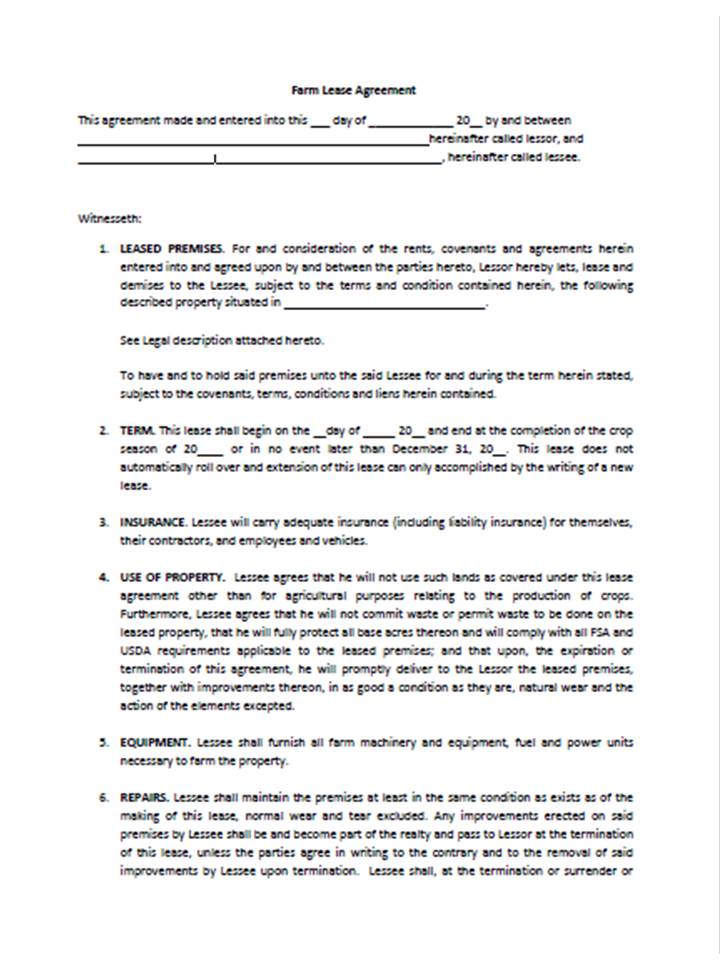
Check out the sample below of what is a typical written cropland cash lease.
If you would like more examples of share crop, cash rent plus leases one or wish to talk to us about any cropland issues don't hesitate to email us at info@ruralkc.com or call us at 913-837-4665.

Friday, September 6, 2013

Different Ways To Lease Farmland

How Involved Do You Want To Be?


There are four ways you as an investor can be involved with the farmland operation.  You can do direct farming which means you are the farmer and you handle everything involved.  You can do custom farming which you don't farm but you take in all the profits.  You can share crop which you share the profits with the farmer.  Or you could just do traditional rent where you would just be a landlord.

What Is Custom Farming?


In custom farming you do everything but farm the land.  You provide the land and management.  You provide the inputs which includes seeds and chemicals.  The farmer would provide the equipment and labor.  You would pay the farmer a lump sum and optionally a percentage of the profits.  You will get all the profits here.  You get all the tax benefits of being a farm operator.  You can take advantage of any government programs available.  You don't have to worry about any expensive equipment cost.  However, you do shoulder all the risk.  For example, if the crop is bad you're the one who suffers.  Remember, the farmer gets paid a lump sum.

What Is Share Cropping?

In share cropping you provide the land.  You may pay part of the expenses.  For example, we will assume you agreed to a 1/3 2/3 crop share.  So you would pay 1/3 of the chemicals.  You would then get 1/3 of the crop income.

The farmer would provide the equipment and the labor.  He would pay 2/3 of the chemical costs.  They would pay all the seed costs and all of the fuel costs.  The farmer would end up getting 2/3 of the crop income.

What Is Cash Rent?

Here the farmer agrees to pay a specified rate per acre regardless of the crop yield.  The advantage of a cash lease is it's predictable and easy to manage.  The disadvantage is that when the prices are high you may be getting less than the value of the land warrants.  

What About A Hybrid Cash Lease?

Here cash rent would be set at a base rate regardless of the crop yield.  A bonus is paid to you if prices hit a certain agreed upon level.  For example, base rent is $125 per acre but corn hit $7.50 at a given date an additional $25 per acre is due.  Or you are given a base cash rent plus a share crop bonus if production is high.  The advantage is it protects your investment if the prices go up.  Disadvantage is it may discourage some farmers from competing for your land.  It may also cause some farmers from paying a high base rent.